Grok Bot alternatives for running your company's work (OpenClaw, Hermes, Rakazo, Squads)

Steven Liechtifounder of Koru
7 minute read

Short answer
The main Grok Bot alternatives are OpenClaw and Hermes Agent, both free, MIT-licensed agents you run on your own hardware with the model you choose, and Rakazo, an open-source, self-hosted take on Grok Bot. Grok Bot is the easiest to start: hosted, always on, with no servers to run.
Grok Bot gives you AI Bots that live on a cloud computer, keep working after you close your laptop, and can hand tasks to each other. If you are using it, or something like it, to run part of a company, it is worth knowing the alternatives and what they trade.
A disclosure first: we are building Koru Squads, which is in this space, so read my view of it with that in mind. Everything about the other products comes from their own docs, sites and repositories, checked on November 1, 2026, and I have left out anything I could not confirm there.
What Grok Bot does well
Grok Bot runs Bots with names, jobs and memory on a persistent cloud computer with a browser, files and a terminal. Bots can message each other, share context in group chats and pass ownership of a task, and skills and routines let them repeat work on a schedule. Apps are available for macOS, Windows, Linux, iOS and Android (Grok Bot overview).
Because the computer is in the cloud, work keeps running with your laptop closed, and sensitive actions can stop for your approval (FAQ). Team Bots let a whole team talk to one Bot, each person in a private chat, with team memory and Slack (Team Bots). It is included in The X Subscription on Premium ($30/month), Super ($100) and Ultra ($200), but not on Plus or Free (X Subscription, x.ai pricing).
The trade-offs people usually mention follow from that design. Grok Bot requires cloud data storage, all of your Bots share one computer, which its FAQ says is not a security boundary, and you don't pick the model. Those are the main reasons to look at Grok Bot alternatives.
Grok Bot alternatives compared
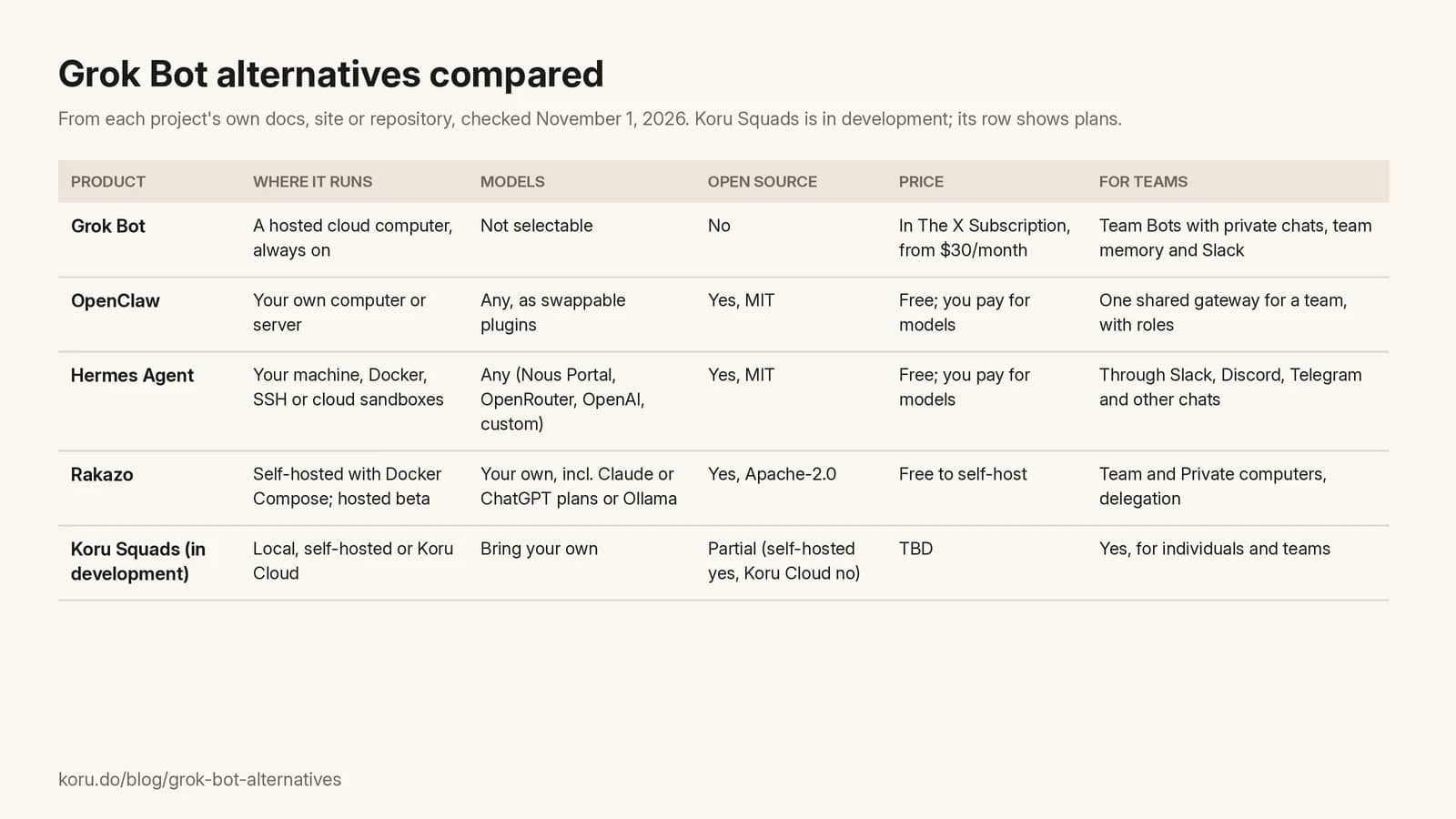
Side by side, as each project describes itself:
| Product | Where it runs | Models | Open source | Price | For teams |
|---|---|---|---|---|---|
| Grok Bot | A hosted cloud computer, always on | Not selectable | No | In The X Subscription, from $30/month | Team Bots with private chats, team memory and Slack |
| OpenClaw | Your own computer or server | Any, as swappable plugins | Yes, MIT | Free; you pay for models | One shared gateway for a team, with roles |
| Hermes Agent | Your machine, Docker, SSH or cloud sandboxes | Any (Nous Portal, OpenRouter, OpenAI, custom) | Yes, MIT | Free; you pay for models | Through Slack, Discord, Telegram and other chats |
| Rakazo | Self-hosted with Docker Compose; hosted beta | Your own, incl. Claude or ChatGPT plans or Ollama | Yes, Apache-2.0 | Free to self-host | Team and Private computers, delegation |
| Koru Squads (in development) | Local, self-hosted or Koru Cloud | Bring your own | Partial (self-hosted yes, Koru Cloud no) | TBD | Yes, for individuals and teams |
OpenClaw: an open-source assistant on your own hardware
OpenClaw is an MIT-licensed personal AI assistant run by the OpenClaw Foundation. It runs on your own computer or server and talks to you where you already chat, with more than 20 channels including Slack, Microsoft Teams, Discord, Telegram, WhatsApp and iMessage. There are apps for macOS, iOS, Android, Windows and Linux, models are swappable plugins, and its state, memory and credentials stay on your hardware (OpenClaw on GitHub).
For a team, OpenClaw runs one gateway with shared sessions and roles, and its docs are clear that everyone on it shares one trust boundary (OpenClaw docs: Teams). There is no paid tier or hosted service, so you run and secure it yourself.
Choose it if you want an assistant that lives on your hardware and in your chat apps. Skip it if you do not want to run a server.
Grok Bot vs Hermes Agent
Hermes Agent, from Nous Research, is a free, MIT-licensed agent with a built-in learning loop: it creates skills from experience, improves them as it uses them, and keeps persistent memory. It schedules jobs, spawns subagents for parallel work, and works with any model through Nous Portal, OpenRouter, OpenAI or your own endpoint (Hermes Agent on GitHub).
The biggest difference from Grok Bot is where the work happens. Grok Bot gives you a hosted cloud computer and manages it for you. Hermes runs where you put it: on your machine, in Docker, over SSH, or in cloud sandboxes such as Modal, Daytona and Vercel Sandbox. You reach it from the terminal or from Telegram, Discord, Slack, WhatsApp, Signal or email. Native Windows is supported, and Hermes Desktop runs on macOS and Windows (Hermes Agent site).
So the choice is mostly about control versus convenience. Hermes is free, lets you choose your model and keeps your data where you run it, but you pay for model usage and look after the setup. Grok Bot costs a subscription and decides the model, but it is always on with nothing to host, and it has native apps and Team Bots for colleagues. Hermes can also import an existing OpenClaw setup, which helps if you are moving between the open-source options.
Rakazo: an open-source, self-hosted Grok Bot alternative
Rakazo describes itself as an open-source, self-hosted alternative to Grok Bot, OpenClaw and Hermes, and it is the closest match to Grok Bot's shape. It runs persistent bots with memory, routines and history on Team and Private computers, lets bots delegate to each other, and has web, desktop, iPhone and Android apps. You bring your own model, including a Claude or ChatGPT subscription or local models through Ollama, and connect tools through Composio, Pipedream or MCP (Rakazo on GitHub).
It is Apache-2.0 licensed and still in beta. You self-host it with Docker Compose, and its site also lists a hosted cloud in beta (rakazo.com).
Choose it if you like how Grok Bot works but want to host it and pick the model. Skip it if you need something past beta.
Using Grok Bot as a chief of staff
One of the roles in Grok Bot's own use cases is a chief of staff: a Bot that owns a source-linked digest of what changed and what needs your attention, from Slack, email, your calendar and planning documents (Grok Bot use cases). Its starter prompt tells the Bot not to send messages or change meetings, which is a sensible default for a role that reads everything.
You can build the same role on the alternatives. Rakazo ships a Chief of Staff template, and OpenClaw or Hermes can run a scheduled digest from the chat apps and tools you connect. Whichever you use, keep the chief of staff read-only at first and give it write access one tool at a time.
Koru Squads: what we are building
Koru Squads is our take on this, and it is in development, not available yet. The idea is a multiplayer AI workspace for your company: you start with a goal and build persistent squads of people and AI agents to run it, with shared company context, handoffs between squads, and human checkpoints for anything that needs approval.
People and agents working together as one team is the vision we are building toward, not a shipped feature, and we have not announced pricing or a date. If that is the shape you want, join the Koru Squads waitlist.
Which Grok Bot alternative should you choose?
- Stay on Grok Bot if you want always-on Bots with nothing to host, native apps and Team Bots, and you are fine with cloud storage and xAI choosing the model.
- OpenClaw if you want a free assistant on your own hardware that lives in your chat apps.
- Hermes Agent if you want a free agent that improves its own skills, with any model and the backend you choose.
- Rakazo if you want something shaped like Grok Bot that you host yourself, and beta is fine.
- Koru Squads if you want to run company goals with squads of people and agents. Join the waitlist.
Frequently asked questions
What are the best Grok Bot alternatives?
OpenClaw and Hermes Agent are free, MIT-licensed agents you run yourself with any model. Rakazo is an open-source, self-hosted alternative shaped like Grok Bot, in beta. Koru Squads, a multiplayer AI workspace for companies, is in development with a waitlist.
Is there an open-source Grok Bot?
Grok Bot itself is not open source. Rakazo describes itself as an open-source, self-hosted alternative to it under Apache-2.0, and OpenClaw and Hermes Agent are open-source agents under MIT.
What is the difference between Grok Bot and Hermes Agent?
Grok Bot runs on a hosted, always-on cloud computer included in The X Subscription from $30 a month, and you do not pick the model. Hermes Agent is free and MIT-licensed, runs where you install it, works with any model and builds its own skills, but you host it and pay for model usage.
Can Grok Bot be a chief of staff?
Yes. Grok Bot's own use cases include a chief of staff Bot that owns a source-linked daily digest from Slack, email, your calendar and planning documents, and its starter prompt keeps it from sending messages or changing meetings.
Is Koru Squads available?
Not yet. Koru Squads is in development, with no announced pricing or date. You can join the waitlist on the Koru Squads page.
Related pages
Drafted with help from AI tools, edited and fact-checked by Steven Liechti.
Related tags
- AI agents
- Comparisons
- Multiplayer AI
Subscribe to receive notifications of new posts
We'll never share your email address.
 Steven Liechti